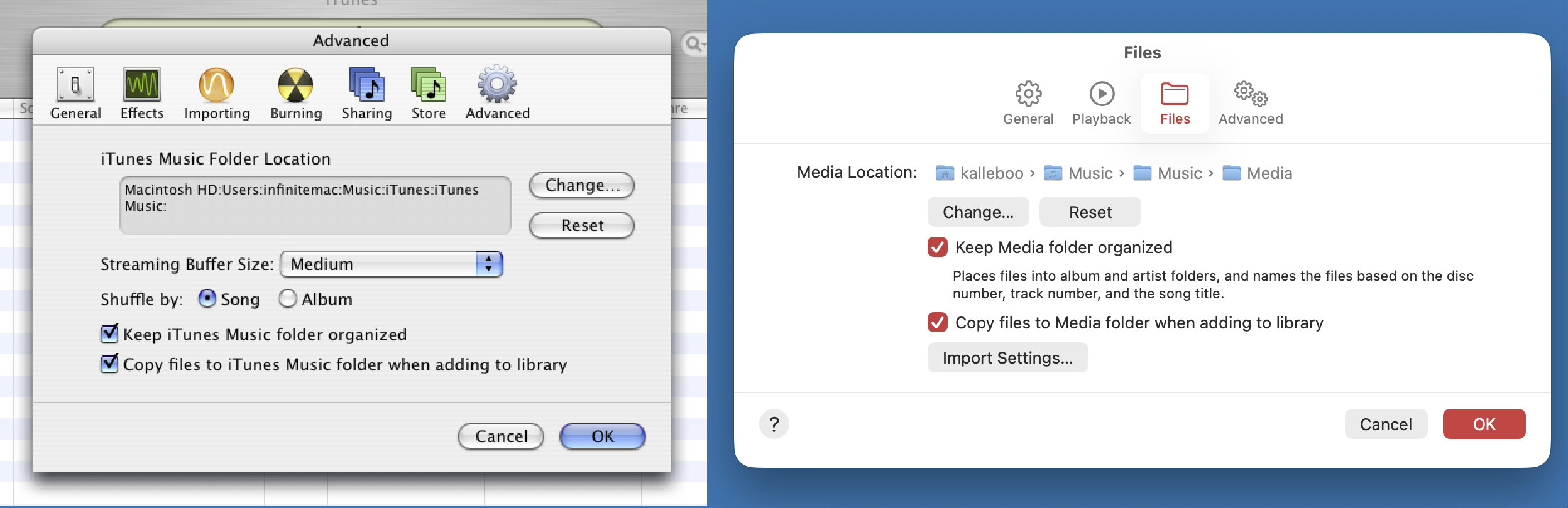
I remember the trick was to use a network hard disk or drive for the music. iTunes kept the organized folders and all files untouched while building its metadata-only archive in local. But in general, yes, the tendency to mess with your file was built-in.
The trick was to skip the onboarding and go into the Preferences, there was an option there to disable putting your files in the music library folder and messing with the layout
edit: I just compared iTunes 4 and Music in Tahoe and they still have the same preference! It's funny how they clearly did a s/iTunes/Music/, resulting in the "Music/Music" dir https://kalleboo.com/linked/itunes4-vs-musictahoe.png
1.44Mb should be enough even for a compressed but still decent quality MP3(~128kb) or AAC(~112kb) short track (1:30+, I think), then you can also reduce audio quality and gain more time based on music styles (lo-fi, etc).
I have one of these in a closet and wondered for years about how to turn it in a distraction free word processor/simple digital typewriter.
Always loved the netbook form factor, and they were cheap!
Funny thing is that probably I also have some 2GB DDR2 stick somewhere. Last thing I need to check for is the battery, I presume it is completely down after all those years.
Anyway, this article will be very handy for this side project. Thank you!
No kidding. Lots of fun to see a system actually boot in about 1 second.
That aside, I've installed all kinds of systems on my trusty 2009 Dell Mini 9, a fanless netbook. For years, this was a CLI-only Tiny Core Linux system, currently running SvarDOS. While on Linux, I even used it to live record 1,5-hour long radio shows via an old Mbox2 audio interface and some CLI recording software. Created a huge ramdisk just in case, but everything went well. Netbooks are weird and interesting machines.
Yeah, wifi on DOS is doable, but very limited in speed and not exactly straightforward to set up (so much that I haven't seriously considered trying myself). Here's an overview and a writeup:
I would say, you install a lightweight Linux, boot directly into your favorite distraction free editor at full screen and sync the files back to phone and big computer via something like syncthing/Nextcloud/etc.
As for which editor that is, it depends a little bit on your needs, but there are ones specifically geared towards being distraction free like https://ghostwriter.kde.org/
Although markdown may not be what you're after. I personally consider formatting another form of distraction, ao this would be a plus for me. But if you write math-heavy papers, going with something else like Typst or LATeX may be a better choice.
I have a related question: In a contest where all the code is generated by LLMs and not hand-coded anymore, does it still make sense to use high-level languages and other abstractions that were created for humans?
I believe so, with Rust being exhibit 1. Rust is known for finding rather a lot of bugs while compiling instead of during debugging. The quote you'll often see is: "If it compiles, it usually runs."
The Rust compiler enforces many code style conditions that you most probably want in your finished program... Type checking, only one thread writing to memory at a time to avoid race conditions, etc.
It is possible to imagine an AI version of Rust that takes this even further in the future.
Maybe not the ones created for humans, but high level languages, probably. More abstract languages ("high level" basically means more abstraction away from the underlying machine, with "low level" being closer to the machine) allow for compression relative to unabstracted languages.
LLMs are known to do worse the more code they have to go through. Therefore, using a high level language where it doesn't have to work with as much code is going to be far more effective.
I actually rewired my internal PC speaker to a big external speaker just so that I could hear the music/sfx of the game in all its glory.
And that awesome intro animation too - never seen anything like it at the time, like simply seeing realistic human faces being drawn in a DOS game was just mind blowing.
Best PC Speaker music ever was Xenon II, by Bomb the Bass[0] (which much later I discovered was a re-rendition of Carpenter' Assault on Precint 13 OST[1]).
May sound silly for some people today, but that was some incredible wizardry at the times, given the limitations (PC speaker was monophonic, square-wave only). As a YouTube comment says: "This is musical equivalent to pixel art."
it's the colour scheme that I remember most strongly. I still think "very prince of persia" when I see certain colour combinations, especially cream and purple.
It was “good enough” for them at the time. Technology is and was always about something good enough for most people. But the Eno quote is about art and aesthetic.
Thanks! Mac build is on the roadmap — it's tracked as a GitHub issue. Right now it's Windows-only but the stack is Tauri 2.0, so macOS support is mostly a signing/packaging task rather than a port. Hoping to have it ready soon.
Google was designed to give you access to knowledge, not think for you and atrophy your brain..
LLMs will melt your brain, and that's by design. You will have no bargaining power , you will be inadequate without access to the Thinking for me SaaS that you allow your brain to become addicted too. You will become a technocratic feudal slave, a serf reliant on the whichever tech-oligarch lets you use their thinking machine. They will pay you pennies.