I wanted to enjoy this post, but I couldn't help but wonder what was plagiarized[0] this time around. Perhaps it was a stupid mistake back then, but tough to look past it.
Doing a reverse google image search seems like he googled for lots of train trips and combined photos from various sources. He's a great marketer, but bad photographer.
Ha, I wanted to say something like, "what a shame that this guy can't escape this infamy", but sure enough, 5 or 6 of those images are the same. Pretty confusing to me, because it seems like he did the trip and presumably could have used his own images – what's the point of this?
He's not a Berkeley student anymore. He graduated two years ago. Slightly ashamed I went to the same school as he did but I suppose he's just a lazy blogger trying to document his trips. Overall a harmless guy.
Strangely the article about trains had a big ad for the article about Singapore Airlines at the bottom. I had a hard time remembering if this was the guy who originated that content or ripped it off. Thanks for the refresher...it's surprising this guy seems to be proud of the content he stole, even now.
>If you want to see tourist America, rent a Cadillac, get on Route 66 and stop off at a few cutesy diners and motels. If you want to see the real America in all its spectacular, crazy, kooky glory, get on the train.
I call BS, and am wondering if he has indeed taken Route 66, or just telling some vague impression he has of what it would be to do so.
I've travelled Route 66 several times (and highway 1, Highway 61 -Louisiana to Canada-, Route 50, coast-to-coast several times, and several other long road trips for decades).
There's nothing "touristy" about Route 66, with the exception of a few small towns along the way with shops living off of the Route 66 travellers.
Considering the whole 2.500+ miles journey, those are a negligible part of the way. And even those few places are not touristy in the Las Vegas or Miami sense, but more of a decadent, quiet "that's what we've got from our past, and we preserve it and tout it to help make some bucks" sense.
And there's nothing (unlike on a train) that stops you from talking small roads and alternate routes to explore nearby smalltowns and counties.
My wife and I did Route 66 from Chicago to St. Louis; that's enough for me. When I lived in LA for a time we meant to hit the end of 66 in San Bernardino but never did.
I think the best parts of the Route are those going through TX, NM and AZ.
Though I say that as somebody for whom those "western"/rocky/deserty looking places were extra enchanting and unfamiliar. So, if you're from the midwest in the first place, I guess it's not the same experience.
>When I lived in LA for a time we meant to hit the end of 66 in San Bernardino but never did.
The "official" end is in Santa Monica (right before the pier), with a memorial plate for the guy they named the highway after etc.
When I lived as a poor vagabond couch-surfer in China, I did almost 100% of my traveling by train.
I'm convinced there's no better way to travel.
When you travel by airplane, you're pretty much rapidly moving from huge city to huge city. You miss everything in-between, from the terrain to seeing how people outside of the cities live.
Even driving from one place to another, you're confined to the freeways. You see a little bit more, but you're still in this weird world which was built around the freeway.
When you travel by train, however, you follow the lay of the land. That takes you into some interesting, fascinating places. Combine that with the fact that you can get a sleeper car and food, and it's an entire experience, not just a rush to get from point A to point B. I spent most of my time reading and looking out the window. It's bliss.
You don't have to take the freeway ("interstate"). You can always go for smaller roads.
>If just yourself, driving 3000 miles cost more time, $, mental energy.
If time, $ and mental energy is at premium, train is not the solution either. A plane ticket will be the same cost or less and take 1/40 the time.
If we're talking about seeing places and travelling to see the "real side, kooky, etc" as he mentions, then driving is a far better option. It doesn't take reading Jack Kerouac to know this.
> If time, $ and mental energy is at premium, train is not the solution either. A plane ticket will be the same cost or less and take 1/40 the time.
That's part of the the point; you don't have to think that way. You actually don't have to think or plan at all. You're not trying to consciously get from point A to point B. You're just sitting, thinking, reading, and going where the train takes you.
It generally takes you to some really interesting places, far from the well-beaten path. I suppose Jack Keroac or someone who would write Zen and the art of Motorcycle Maintenance may do the same thing in a car, but I've never done so.
>It generally takes you to some really interesting places, far from the well-beaten path.
You have a point on the "relaxing" thing. OTOH, the problem I see with that is that it doesn't really "take" you to those places, it just passes through them. You can watch them go by, but not stop and check them out.
It really depends what you're up for. I would take the train again in a heartbeat if it lined up logistically. But I'm not currently looking to invest in another road trip.
A plane makes a single day into a complete waste, plus the stress of having to deal with blue shirted fondlers and their enabling hordes who worship that "terrorism" tripe. But it gets you there the quickest.
Driving interstates/secondary highways direct wastes several days, but perhaps you have a bunch of stuff to transport. If you did this and enjoyed "seeing the country", you owe it to yourself to plan another trip with more time.
Taking the train uses several days, but they're relaxing and you can appreciate the scenery transitions without having to worry about logistics. It's probably the easiest way to "see things" while your goal is still the destination.
A proper road trip will let you see what you can see from the train, plus a whole lot more, plus actually stopping and checking things out rather than just passing by. But the journey itself has to be your goal. I wouldn't recommend it for any less than 8 days (one way), otherwise you're just doing a slower canonball run.
They're saying you don't have to focus on driving. On a train you can watch the scenery pass and not pay attention to piloting your mode of transportation.
>Even driving from one place to another, you're confined to the freeways.
Plane to train is also the same as train to car.
The US has all sorts of non-expressway routes that are fun to drive and you see so much culture, culture you can actually stop and interact with trivially. For example, the classic Route 66, which you can still drive today. Or make your own routes with all this fancy GPS stuff we have today.
There's something wonderful about cars that I think we're going to miss as we continue to urbanize and move into self-driving taxi's or other exotic tech. The few long drives I've take out of the city have been very pleasurable.
My wife and I always do this with pleasure trips. For a premium of 10%-20% time versus the Interstate, you can see and experience so much more.
One of my favorite things is to stop and photograph the crumbling remains of past glory. I've got a vague idea of collecting the works together into a show or book, trying to illustrate the fleeting nature of our dreams.
I've done the pacific starlight from SF to Portland/Seattle a couple times over the years, and while I love the scenic-ness of the train, I felt like the author painted a bit too rosy of a picture of the amtrak.
Here's my anecdotal list of downsides of amtrak train riding:
- People will talk on their cell phones in the cabin despite the rules. You wouldn't think this a big annoyance, but it gets annoying after several hours.
- Amtrak cars can have issues - I spent 12 hours in one with a door that kept opening and closing making a huge 'clunk' noise every 30 seconds. A passenger finally figured out a way to make it stuck open.
- Watch your stuff, Things can and will get stolen - particularly in areas where there's multiple close stops (e.g. the stops near seattle) - last time the person in the seat in front had their smartphone stolen while they took a brief break in the snack car.
- The co2 savings compared to flying depends on the actual route and timing - I have to point this out because amtrak does market themselves a bit on co2 savings - I calculated this once between flying and taking the train from seattle to spokane, and after factoring in the need to stay at a hotel an extra night for the train along with it's non-direct route, the co2 difference was negligible. Here's my math for those curious: https://i.imgur.com/zTHfSB8.png
- Certain trains are historically, tragically slow -
amtrak has a website logging the timeliness of trains, typically 70% on time for a long train is on the good side.
This said, I do want trains to be more of a thing here - I've had great experiences with the ones in europe, wish the pioneer train ( http://pioneertrain.org ) and ski train ( http://www.skitrain.com/ ) make a comeback, and prefer taking the business class amtrak trains for shorter trips over flying or driving. Plus you can pack a folding bike like a brompton on amtrak just by tossing it into the overhead compartment.
I couldn't help but compare this to my experiences of driving coast-to-coast. Note that about half of the article and far more of the words are dedicated to the first day. The second gets some space, but the third and fourth are barely there. What little there is is all about things other than the view. That very much mirrors my memories of my drive (vancouver-seattle-boston x6, mostly all i090/94).
In short: The coastal and rocky mountains are interesting. But after that the US is flat flat flatter and more flat. That first Midwestern wheat field is cool, but numbers 2 through 15239 are not. At least during the nights I'd see some deer. I remember driving for five hours without even touching the clutch. Then you hit the hills of the east coast. Wow. A tiny gravel river. A rusty old mill. If I run through my memories of the drive, the west is filled with images of places and people. The east is filled with traffic, gray concrete and rusty bridges. If I were doing this for fun I'd have turned around and repeated day one.
You should have went East to West. Probably similar impressions, only the other way around. :)
I've found that each vertical slice of the country has it's best parts. I love the hill country in Texas, the painted desert in NM, the Great Lakes, the Louisiana bayous, New England meadows, the Blue Ridge Mountains.
The real problem here is that it is very difficult to take one trip and hit all of these points while traveling.
I did. I was driving to and from school on the east coast. (Doing this meant I didn't need to transfer my car to the US.) The biggest difference in driving direction was the sun. I don't know why, but sunrises always seem shorter than sunsets. Heading east is therefore easier than west because you spend less time with the sun in your eyes. The change in timezones also made heading west 6hours faster, partially explaining the longer sunsets.
One tricky bit with a one-way train journey like this is that the train travels all night. So roughly 1/3 of the scenery you go through, you won't be able to see at all. If you have something in particular to see, like the badlands, it might only be visible going eastbound and not westbound.
I've taken the chicago-NY route he mentions in the story. He has no pix because its dark both ways. The eastbound leaves around late dinner time in CHC (no point eating before boarding) and arrives before lunch in NYC, and westbound leaves NYC in mid-late afternoon right before lunch hour and arrives around rush hour in CHC. Unless they've changed schedules again. So the time "cost" of taking the train isn't 12 hours vs 3 hour flight (+ 3 hours for security and boarding + an hour each side cab ride... wait suddenly the train isn't that slow after all) The cost of taking the train is you sleep aboard and lose like a quarter of a day of awake time, its nothing. And its a REALLY good working environment.
Three points of advice regarding the "expensive" sleeper car: You pay for food unless you get an expensive sleeper, in which case meals are free. Suddenly that room is not so expensive. A hotel out in the burbs or even in a recreational area is cheap, making the sleeper car look expensive; however I'm avoiding staying in NYC or CHC for a night, and hotel rooms downtown are very expensive, suddenly the sleeper is looking like a good deal. Finally the station in CHC and NYC is right downtown. I've gone to business meetings and training in CHC literally two minutes walk from the station, suddenly not paying for a cab to/from Ohare and pay parking for my car at the airport is making the sleeper car downright cheap... As a room a sleeper car is expensive, as a total systemic cost of the overall trip from home front door and back again, its probably cheaper to take the train with a sleeper cabin than to fly.
That is one of the nice parts about the schedule of the California Zephyr - both directions give you the mountains of Colorado during daylight. In the winter you might miss some of Utah's desert because of the shorter days, but you get at least a taste of it. And you end up sleeping through most of Nebraska in both directions as well. Nothing against Nebraska, but it looks much the same as Iowa, so a half day of looking at farms in Iowa is enough - no need for 8 more hours of it in Nebraska.
I've lived in various locations on that route for most of my adult life, and take the train often enough that the conductors are starting to remember me.
Agreed. Unless you're parked in a railroad yard for 10 hours waiting for an engine, like we were. Feels pretty vulnerable; not a place I'd choose to sleep normally.
On the plus side: I can say I've slept in an abandoned rail car on a siding now.
Sadly this is very common. The freight companies own the rails, and if there's ever a route conflict their trains get priority over passenger trains. This means long delays in shitty railyards, and you have no way of making an itinerary.
Federal law mandates Amtrak priority over freight, even when operating on freight railways, but my understanding is that the law is not often followed.
Only if they're running on time. And they're never running on time over the longer routes.
I once took the train from Chicago to Denver and back.
On the return trip, our train was delayed 24 hours total. We spent an entire extra day stuck on sidings in the middle of nowhere, as freight cars passed us by.
Ofttimes in those situations, the passengers are offloaded onto coach buses, but there were no paved roads nearby.
The U.S. just doesn't do passenger rail well. This wasn't the first time I had a bad Amtrak experience. I have, in fact, never been on an Amtrak train that has arrived at my destination before 150% of the scheduled travel time has elapsed.
I went NY->Chicago->SF, the reverse of the route in the OP. We were held up for about 3 hours in Helper, UT, due to a washed out track. It was a really positive experience. Many passengers were gathered in the observation car, and one guy had a guitar with him. We spent much of the time having a singalong.
And once we got past the washout, the train was positively flying - we made it into SF only about 1/2 hour late.
I loved pretty much the whole thing. High points were watching the scenery, and also interacting with other passengers - both in the observation car and, as the OP notes, at meals. But I'm really glad we did it "1st class" - that is, with a sleeper cabin. This was comfortable and quiet, and provided a way we could make it "our experience" when we didn't want to be stuck with the rest of the crowd.
The sleeper car is much more expensive, but includes meals. All told, I think the price of the three day trip including sleeper cabin and meals, works out similar to airfare plus hotels and meals for a similar time period.
Countering anecdata: I've taken the CA Zephyr from Emeryville to Grand Junction twice, and arrived on-time with the first and I think 30 mins late with the second. With a mobile phone as a hotspot, and sone snacks in the bag for lunch, it was a very nice trip!
30 minutes late on a 24 hour trip is not horrible. That's only 2% late. But 24 hours late on a 18.6 hour trip is 129% late. That's packing a lunch, eating it, then eating the snacks you packed because you know Amtrak runs late very often, then having another five meals on the train that you didn't plan for, because you never expected even Amtrak to screw up this badly. And this was before mobile hotspots. It was finishing your book, then finishing all the puzzles in your GAMES Magazine, then rereading all of yesterday's newspaper, down to the obituaries from a city you don't even live in, then staring out your window at the featureless nothingness of the Great Plains.
Your traveling companions go from "what an adventure!" to "maybe air travel with a baby over a holiday weekend wouldn't have been so bad," to pandemic cabin fever, to plotting the violent overthrow of the conductor with the guy you just met in the next car.
A ranking executive of Amtrak would literally have to kiss me on my literal ass and hand me a free first-class private sleeper cabin ticket before I would even set foot in another one of their siding-idlers ever again.
I did the math later, and determined that, while it would not have been accurate to say "it would have been quicker to walk", a professional touring cyclist would have been able to beat the train in a race, even including an 8-hour rest break, if he was taking all the performance-enhancing drugs and riding a faired recumbent bike.
I think that Amtrak gets priority if they're on schedule. But if they're not, the "hole" in the freight traffic may be gone. At that point the freight railroad will do the best they can for Amtrak without bringing the rest of the railroad to a halt.
But that's just my amateur understanding of the situation...
"An hour later, at a small Nevada town, there was a scene of confusion as the train pulled into the station with police cars standing by. The police boarded the train and arrested my dinner companion on suspicion of possessing firearms."
On the other hand, its totally legal in Nevada to open carry; a permit is required only for concealed carry. So I'm wondering what the fuss was about.
The time I took Amtrak cross country, my seat friend was "Ralph". He was nicely dressed, in the "import trucking" business, didn't like flying, and upgraded to a sleeper cabin with cash. The FBI got on at ABQ and started harassing people for their tickets. I was in the observation car at the time, but when I returned to my seat Ralph was still there! He had been hitting on the train attendant the whole time, and now she was giving him shit about the FBI's visit. He kept insisting they "just wanted to talk". I've no idea if he somehow successfully dodged them, or if they just wanted to scare him, or perhaps the train is a great place to do an exchange with an informant.
I'd imagine there's a lot of riff-raff (I use this word lovingly) on the train, because flying is hopelessly facist in the technical sense - eg that dance of responsibility that makes for the mandatory pervsearch. On the train you at least retain some skeleton of rights.
IMHO going West->East is the wrong way for scenery. All of the pretty geology up front, then flat nothingness for the remaining two thirds. At least this is my recollection of driving (I'm not even out of Colorado yet?!). Going East->West, there's a nice progression that keeps one entertained the whole time. But perhaps it's different to west coast native eyes as the green really starts filling in.
I was only aware of it because I was sitting next to him, with the only result being telling the story to friends, and writing this comment several years later. I presume whatever questioning/etc they did do was in a private.
I would take this with a grain of salt as this man is known to plagiarize and make up content in his previous posts. Also given that he took a picture of everyone and everything you think he would not do anything in the world to get a picture of that scene?
Unloaded in checked baggage has been legal since 2010. So he must have made a mistake, kept a handgun in personal baggage? Not worth 6 squad cars in my opinion. Maybe a kind reminder, and move it to his checked bag?
Ah, but your opinion isn't what sends squad cars out. I didn't think that exploring an abandoned mall warranted five squad cars, two fire engines and a helicopter, but the Allen police department disagreed with me.
This is sort of my dream, but every time I've checked prices they have been astronomical, upwards of, say, $800 to go from Emeryville to Florida (just a regular coach seat).
It's possible that it gets cheaper in winter. My wife and I did exactly this trip but around christmas-time and it was fantastic. IIRC we paid a similar price but for the little cabin instead of the chair car.
A lot of American friends were surprised we were doing this - they had this idea that it would be uncomfortable and boring. They just couldn't have been more wrong. Between the comfortable room-ette things, often very friendly and varied fellow travellers, surprisingly tasty food and absolutely amazing scenery, it's a fond memory.
Of course, we scheduled in plenty of time - if you need to be somewhere punctually, Amtrak is not really your best bet.
I guess I stand corrected. I was just looking at this last week and I would swear the prices were in the $800 range, although it's possible I'm going crazy.
I've taken this trip before; round trip between Chicago and SF for an Erlang course. It's so beautiful (at almost every point along the SF to Salt Lake leg described here) that sometimes after coming around turns, you'll hear the entire carriage audibly gasp in awe about the new scenery. Strangers talk to each other a lot - it feels as much like a ride as a trip.
My father was in the UK RAF in WW2 and for some reason had to cross the US by train from Florida to Hollywood - he always spoke very fondly of that trip.
[NB He was always rather vague as to why he had to cross the US by train, but in between stints in North Africa, Arctic Canada and the Bahamas he seemed to have an interesting war]
Worth noting re US train travel: "Based on data spanning the period 2004-12, for example, to expect one transit-related injury, a passenger would need to ride the French railroad for 4.9 million miles or the German railroad for 4.1 million miles. Yet he would need to ride America's railroads for only 84,300 miles, on average, to sustain one injury."
84k miles isn't very far. This was a 3400mile journey. So you are likely hurt/dead after doing this 25 times in the US, or 1500 times in Germany.
The numbers are a bit of an exaggeration as many US train deaths involve non-passengers (ie at train crossings) but I think my point stands. Train travel, US trains in particular, is not as safe as it may seem.
       41 non-fatal conditions for Train Accidents
          Excluding Highway-Rail Crossing (HRC) Incidents
      112 non-fatal conditions for Highway-Rail Crossing (HRC) Incidents
    1,213 non-fatal conditions for Other Incidents, Excluding HRC
I can find that "Other Incidents" means "not train accidents or crossing incidents" ... but I don't know what that means. Knife fights in the observation lounge? A high incidence of getting drunk, falling, and knocking oneself on the head? Do the European numbers use the same categories?
If we leave out that large but unknown category, it looks about 10x safer than the numbers sandworm101 gave. Still worse than Germany by a factor of 5.
I've done the much shorter 12 hour trip from Prince George to Prince Rupert, British Columbia followed by the similar length ferry trip through the inside passage to Port Hardy on Vancouver Island. The scenery on both are absolutely incredible, but I still got bored. Twelve plus hours of good scenery is just too much no matter how beautiful it is. That said, I still hope to one day take the railway clear across Canada and/or the trip across the U.S. and/or the trans-Siberian railroad. However, I will make certain to have substantial stopovers to break up the journey. I will also make certain I have plenty to read or write or code; I do think it would be an ideal place to work. Hack across America, anyone?
the photo of downtown Denver was taken from the Denver Museum of Nature and Science, looking across Ferril Lake. I have a 60x40 print of a photo my brother took from the same spot [0] hanging on my living room wall.
I was a little surprised he spent 2 days in and around Denver, but didn't post any photos of Red Rocks [1].
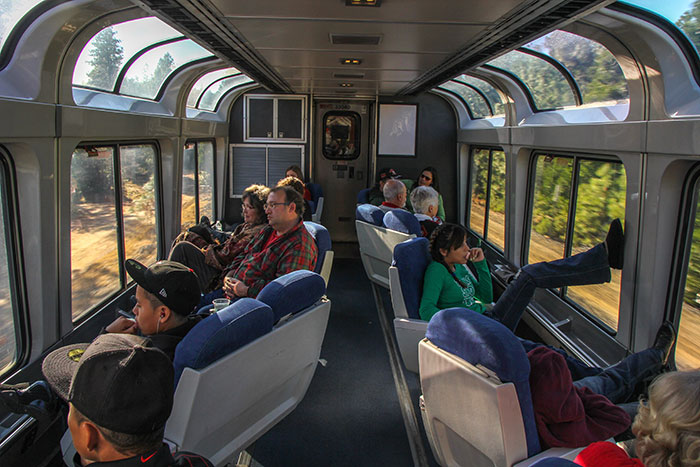
It's a difference in cultural expectations. As I found out recently, putting one's feet on the table is considered rude in Germany.
If you come from a culture where picking your nose in public is impolite, then it might disturb you to see someone really going at it. In the US, using the middle finger is generally considered rude or offensive, but the act on its own is meaningless and not especially prone to damage anything.
But acts do have cultural associations, which is why putting feet on a table, or window frame, may disturb others, even if it doesn't disturb you.
Personally, I have no problems with foot-on-frame.
For the most part Amtrak runs on rails owned and maintained by private companies. Plenty of exceptions - especially the Northeast Corridor - but the vast majority of track is outside government control.
I would say very few exceptions, other than the the Northeast Corridor. There are some tracks in a few other places (LA and Chicago, mainly) owned by commuter rail authorities, but so far as I know, the Northeast Corridor is the only real intercity line not owned by a private company.


[0]: https://www.reddit.com/r/singapore/comments/2huw34/what_its_...
EDIT: Looks like a lot of it. Sigh.