High framerates give the appearance of and in some cases substantially better images reducing significantly various temporal aliasing effects. They are without doubt better in every way from a technical point of view.
There is however a cultural issue that is worst amongst the film creators that "film" is regarded as expensive, high-end and good so that things that don't have the artefacts (low frame rate, film grain and colour) are regarded with at least suspicion. This will probably pass with time especially as the number of high budget, high quality TV series increases.
I feel like I'll go mental if I hear one more film buff talk about the essential nature of various imperfections in traditional film. It's so obvious that nobody would have chosen to go with film grain, low frame rates, or any of the other limitations that were foist upon them if they had had a choice. But now these technical limitations get enshrined as the medium's supposed true nature, at least by some....
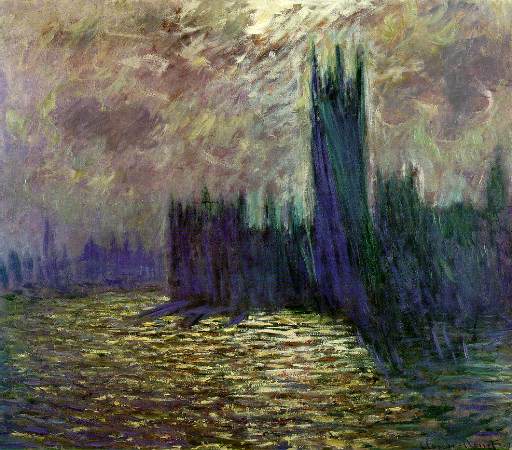
As in so many creative endeavours it's the limitations which make the art. It's not always about going for perfection, but it always has to be emotional.
There's no question that the latter is more technically accurate, more lifelike, more realistic, but it lacks the guttural punch of the Monet. Monet was a master, but only by exploiting the limitations of his medium could he attain that mastery.
So it goes with film. A decent cinematographer uses the inherent faults of film to convey emotion. Without the low dynamic range of film, the dark corners of the Nostromo in Alien would have looked like a plywood movie set. Without lens flare and blown highlights then the plight of a dehydrated hero in the desert would be much harder to get across. Those things - 24fps, lens flare, low range, depth of field - have become part of our shared culture now. So much so that even media which aim for perfect realism (eg video games) mimic some of them to aid immersion and, once again, heighten the emotional response.
It's one thing to creatively take advantage of limitations to make art better. It's quite another to insist that an arbitrary limitation must be present on every work, regardless of whether it's good or not.
If 24fps is somehow good for certain types of film, then by all means, keep using it. But it's silly to say that 24fps is universally better, as I've heard some people say.
You point is well taken, but just as a minor nit, I wanted to add that artists did achieve photorealism first and then move on to abstractness. Arguably, that was driven by the advent of photography which commoditized photorealism.
Fair point. Impressionism was in no small part a reaction to the overly stuffy and formal schools of realistic painting of the time. You've made me think: I wonder how much photography contributed to their frustration with that academic painting style?
But still, painting is painting. Take the Dutch Old Masters: incredibly realistic, lifelike pictures, but also extraordinarily powerful. One doesn't preclude the other, but in every case something about the medium contributes to its power. It might be the fact that a sitter for one of Caravaggio's Christs was actually suffering due to holding his body in place for so long; it could be a need to invent some aspect of light in a scene which ends up illuminating a girl's face in a particularly lovely way.
There's plenty of emotion in photography, too, but it tends to come as a result of skilful use of that medium's own characteristics: spontaneity, completeness, and presence. Press photographs are a great example, exploiting the medium's immediacy to steal a few, shocking milliseconds of reality. That applies even to powerful landscape photographs, in the opposite way: They are very carefully staged, manipulated and contrived, all simply a way to align the limitations of the medium (only 1/500th of a second to make an image) with a particularly beautiful instant of passing space-time.
The second one, no question about it. It make me think of storms and fog and winter.
The first one made me think of cartoon depictions of the evil lair and children's drawings. It also looked like those ink blob psychological tests were you can see anything you want in the picture. (Which is presumably why you like it better.)
I'm a bit of a film buff, by that I mean I like shooting of film & I own 16mm film cameras. (I shoot most if my work in digital though, so I don't consider myself all that snobby about it)
To me some arguments for film hold up, but are rapidly becoming less relevant as digital sensors improve. The biggest case form film to me is the dynamic range (in film terms "latitude") compared to digital. Film is currently still better at retaining detail in high contrast shots (for example a person dimly lit against a bright sky). And when film does "blow out" it has a tendency to be a smooth curve and even the over-exposed parts of the frame that may be fully white still have some texture. Whereas digital has a harsh drop off where the information is just gone and it has a rather ugly look.
Newer camera sensors are starting to get very, very close to film in terms of latitude. But for the moment even the most expensive Hollywood level cameras are not quite as good. I expect this to change and eventually film won't have this advantage anymore.
Film does tend to have a pleasing, organic look. But plugins are getting very good at emulating the good parts of that without all of the hassles of film. I liken it to audio recording, which went through a similar analog-vs-digital revolution in the 90's. there are still people that choose analog for artistic reasons, but digital is accepted as the primary recording medium now.
As for 48fps, though, that's irrelevant in the digital-vs-film argument because both types of cameras can shoot at either frame rate.
Latitude is something I am more interested in too. But, once I've tried Sony SRW-9000PL I was blown away. Full 12 stops, image looked (stock) like it was hand delivered from heaven without any lighting used (I had it only for a test), and even digital noise was pleasing, film like, in low light situations. I can only imagine what F-65 does then if 9k did that. Hell, even RED, post MX sensor, looks really great.
Film has a charm to itself though (even just watching rushes projectioned vs monitor), but from a practical standpoint it's dead and gone. When you factor in a cost of stock only for a 90 minute film (with a, standard, coverage of 20:1 or 30:!) you have to pay for it as much as a new digital camera. Not to mention developing, scanning, handling, storing it...
Yea it seems like in the last year or two the sensors are finally starting to increase the latitude very close to film. I've heard film was 13-14 stops and digital cameras are just starting to hit near the 13 stop level. It's getting to the point where I can't even tell sometimes and I consider myself pretty well tuned into that!
I think it's a pretty exciting time actually in camera technology. I think film will still be an artistic choice for a while. Directors like Spielberg and Tarantino have claimed they will never stop shooting on film. But, I heard that same kind of stuff about audio back in the 90s, so we'll see!
I'm also one of those guys waiting on my pre-order of a black magic cinema camera which claims 13 stops, so I'm pretty excited to get my hands on it!
I'm perfectly fine with preferring film for things that film is better at. Stuff like the dynamic range you mention is an excellent example of this. I'm not sure if digital has caught up in terms of raw resolution, either. Arguments like this make a ton of sense: if film is actually better for something, then that's a reason to prefer it.
I only have problems with weird arguments where people prefer stuff that's obviously worse, like the aforementioned grain and low frame rates.
Hmm? There's all sorts of "noise" that are generally considered a positive thing, at least in certain contexts. After all, the end goal in most cases isn't perfect information capture, it's communicating emotion/feeling/message/etc, and "degrading" an image can add something (just not the original thing).
Of course the correlation between certain types of noise/distortion and the resulting interpretation is in many cases culturally determined, and that changes over time... One minute shakycam is considered the height of immersion, the next, it's an embarrassing affectation.
But still, there's nothing inherently wrong with preferring something "worse," especially when the latter judgment is made on a narrow technical basis which misses the larger picture.
Film is more than just the quality of the image - it's about the mindset you approach shooting. If you're shooting on film you'll be lucky if you can have more than a 3:1 overrun. On digital it's much higher...you can afford to shoot more because you're not paying processing costs. Directors working with film shoot in a very different way to digital, and this does affect the final product: I know not because I'm a film buff, but because I used to crew on shoots with both formats.
I love digital, I love film. I'd like directors to have a choice, but I suspect we'll see studios effectively enforcing digital for all but the most influential directors going forward.
Of course. Anything of this nature can be used to good effect, but they should never be imposed on everything just because people are used to inferior technology.
So, yes, increased framerates do make things like aliasing concerns -- long the bane of many an action movie director's existence -- go away. However, there is a concrete and visceral difference between 24fps and 30/48 that is impossible to ignore (unlike, say vinyl vs. digital, which requires an expert and a dollop of wishful thinking to recognize). This is not something that only the snooty directors and film buffs will notice -- everyone (and I mean everyone) in the theater will comment on it.
Now, perhaps we all as species just need to adjust to the new normal. We'll see. Personally, I find that 24fps adds a sense of larger-than-lifeness that I find really attractive. Maybe I'll just get over it, but I suspect that I'll miss 24fps for quite a while.
I thought that was an actual issue dealing with "loudness" and the dynamic range of the sound. ie, newer media is formatted so that it's so loud, it will clip parts off before it you can hear the softer bits in it. I could be way off though, I'm not really and audio buff in that sense...
It was more a case of hard clipping vs soft clipping. You could get tube ( valve ) amplifiers moving high tension volts way over spec at the cost of lots of third harmonic ( mostly ) distortion by providing things like DC amplifiers. Semiconductor amplifiers would simply turn into a digital switch with enough current. Fast enough current and they're more or less flip flops.
Normalising within 16 bits has led to loudness wars. That's the medium. Analogue chains all overflow towards a chaotic end. Some people prefer that chain of events.
You're confusing a couple of things here. DR is substantially increased with digital recording; so is SNR. Behaviour at the upper end of the DR differs between digital and analog media. Whereas tape, for instance, saturates (which may induce pleasant distortion!), digital audio clips (which induces headaches). However, that doesn't really matter in practice if the audio engineer in question is worth his salt. Levels at every point of the digital chain need to be adjusted accordingly: the old strategy of keeping everything close-to-maximum doesn't work anymore. One keeps everything well below clipping point instead.
Overeager compression (specifically, limiting) is a whole different problem, especially with modern pop production.
"Loudness" is an orthogonal debate revolving around mixing (pop music). There's nothing about the various media that requires or prohibits one from mixing 'loud'.
vinyl vs CD, tube vs solid-state/digital -- those are more similar to film's 24fps vs higher frame rates: straightforward arguments against higher-fidelity technologies because we've grown emotionally attached to the particular artifacts of legacy technologies.



There is however a cultural issue that is worst amongst the film creators that "film" is regarded as expensive, high-end and good so that things that don't have the artefacts (low frame rate, film grain and colour) are regarded with at least suspicion. This will probably pass with time especially as the number of high budget, high quality TV series increases.