There's a scene in "Brave" (the animated movie) where you see Merida fire an arrow. The scene is rendered in slow motion and you can see the arrow flex as it leaves the bow. I knew that arrows flex as they are being fired, but this was the first time I had seen it in slow motion. Comparing what I saw in the movie with this video suggests to me that the animators did a very good job of getting this detail right.
That scene is impressively accurate in ways few people will notice:
In addition to the awesome slow motion, there are three boys who shoot before Merida starts her shooting. The first two miss horribly, and the third one gets a bull's eye on the sheer chance that he was startled as he was loosing the arrow. What's interesting is that all three have different types of bad form seen in real life, and they miss (or hit) in the way someone who has that bad form would.
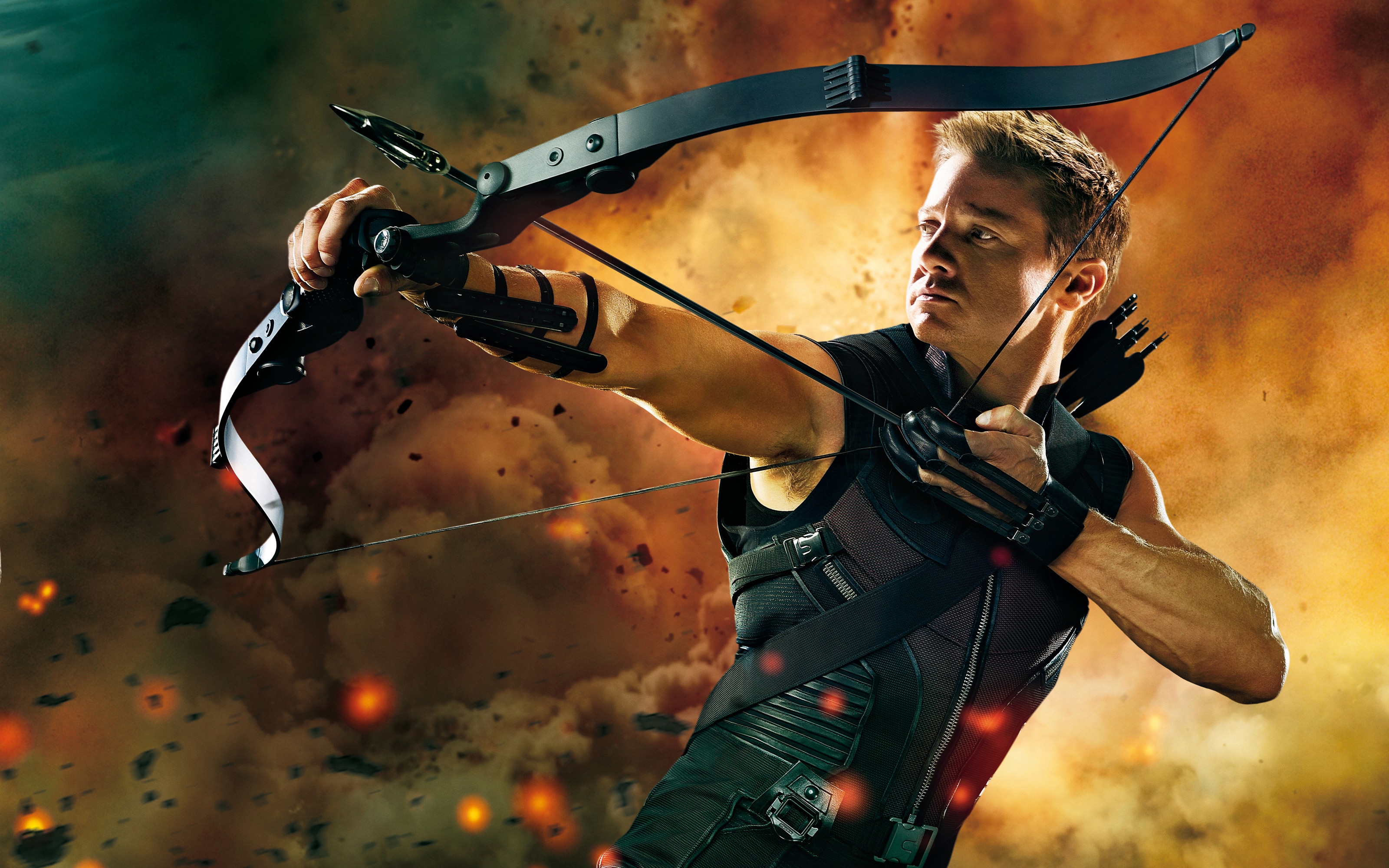
In the promo pics for the Avengers movie, Hawkeye was wearing double arm guards. As I understand it, they are only worn by n00bs who haven't learned to rotate their elbow to the right instead of down. (Try it. You will see what I mean.)
It's virtually impossible to not hit your forearm assuming you are doing everything correctly. If you look at all the high level recurve comps, everyone has an an arm gaurd. The same is true for chest protectors.
Google videos of the World Champs or Oylmpics and you'll see what I mean.
Even if this were not the case, why risk it? You don't want to get hit by a bow string on a 44lb bow in the middle of a comp.
When I was shooting bows, if you did things properly, you wouldn't hit your forearm. The problem is if you blow chow and don't notch the arrow properly. Or the notch blows out. Or the arrow shatters when you let loose. Then the string will hit your arm. I got hit once with a 35lb bow. I don't want to get bit by a 60-70 lb bow string nohow no way.
The angle between your arrow and bow arm may have been too high.
The strongest position is when your arms and shoulders form a straight line (with your shoulders low). So the closer to parallel the line of the arrow is to this, the easier it is to hold.
Now, technically you are correct. If your release is perfectly clean there should be no problem. But in reality, there will be some degree of 'plucking' going on. Your fingers can't open fast enough. So the string actually vibrates a bit from side to side. I have seen some weird follow throughs that avoid this problem.
There are very few top recurve archers that shoot without a guard.
arm guards are worn by all Olympic-style archers (there are some traditional archery styles where they are slightly less common), but wearing two arm guards is something you might see at summer camp before the counselor gets the chance to show how the equipment should be used...
AIUI, you're exactly right. He wore two arm guards because he kept hitting his arm. Of course, my source for this is reddit comment threads back when Avengers first came out, so make of that what you will.
In the picture you linked, he's not wearing two arm guards. He has an arm guard on his left arm (the one holding the bow), and a finger guard on the right (the one drawing the string).
The details in modern animation are impressive. I've seen behind the scenes videos where the animators will do research on such small details, such as the arrow bending. I remember seeing them study animal fur in great detail to make Monsters, inc. realistic.
Wouldn't you want your arrow to wobble so that it has a node right at the tip? The archer they interview says he that he times the wobble to be able to hit an aspirin, but in the slow motion video at the end, you can see that while the arrow shaft wobbles a lot, the tip of the arrow remains relatively true.
That would be ideal. Unfortunately the boundary conditions are wrong. Since each end of the arrow is free, you get anti-nodes at the ends, just like in open air columns:
and nodes from the second harmonic (which dominate the motion) at about a quarter of the length in from the ends.
There is some black magic/hard engineering that goes into matching arrow stiffness and length against tip weight and bow strength to produce optimally timed and placed vibrations, but I've never dug deeply into it.
Not likely. The flex of an arrow is probably not quite symmetrical due to the weight of the point. As mentioned, the point wobbles less than the nock end. You can do things adjust the flexing.
Modern recurve archers generally spend time "tuning" their setup. You can change arrow stiffness (spine), point weight (heavier gives a "softer" arrow, lighter gives a "stiffer" arrow), plunger offset and plunger spring stiffness. Arrow length is generally fixed if you are using a clicker.
There's also some leeway with poundage. You can screw the limb bolts in or out to increase or decrease the poundage. And if you have money, buy X10s or ACEs. They have barreled shafts and in my experience are easier to tune.
Barebow archers (like the guy in the video) have far fewer variables and I think they just measure shafts to get the right tune. I've seen some go through a lot of shafts to get usable arrows.
He very specifically tests all his arrows for how much they flex, and if it's outside his tolerance, he doesn't use it (as explained in the video). In this way, he is able to normalize the deflection of the arrows he uses, and correctly predict the deflection offset.
Are the ends of the arrow free, though? It's moving through the air fast enough that I'd imagine there'd be lift/drag effects if it's not head-on to the airstream.
He says that the two nodes (tip and shaft) determine the direction of velocity. So the concern is which way the arrow is pointing after the initial bend around the bow, not any later wobble.
i have been an avid watcher of Destin's material, and my girls (3 & 6) love to watch as well. if you haven't checked out his other stuff, it is pretty much all excellent and enlightening (its not ALL high speed magic -- for example he has a bit about inverted bicycle which is really fascinating)
The backwards bicycle one is awesome because he actually spent 8 months learning to ride the ridiculous thing, and then filmed himself trying to ride a regular bike: www.youtube.com/watch?v=MFzDaBzBlL0
The way the video is shot is really awesome (first-person, timely changes, slow motion, etc)... even if he does look a bit goofy with the gopro strapped to his head like a mining light.
Has anybody tried making arrows with increased damping? I searched briefly, found nothing.
This would extinguish the flex oscillation more rapidly. I wonder if this would affect arrow performance one way or the other.
With carbon arrows, you might do it by using a lower modulus matrix material, which would dissipate flex energy faster than the high modulus epoxy they likely use. The arrow flex amplitude should be determined by the carbon fiber modulus and layup pattern. Oscillation ringdown (damping) should mostly be a function of matrix material energy dissipation, since the carbon fiber has very low damping.
Wow. Anyone else feel like this is a classical, macro scale version of wave-particle duality?
The arrow, despite projecting like a particle, is also a wave in how it flexes. It goes "through" the bow's wood[1] by having just the right wavelength for this vibration mode that its nodes point it toward the target rather than letting the arrow project along a line tangent to the wood.
Does that analogy of the dynamic work?
[1] don't know the technical term; best I could find was "back" or "belly"
Regarding terminology: The back of the bow is the part facing away from you; Belly is the part facing towards you.
And regarding the particle wave duality -- not so much. The interesting part of the particle wave duality is that the "waveicles" actually act like waves in the ocean, spreading in all directions, interfering with each other, diffracting and reflecting, and so on. It gets even weirder when you ask what they are waves of: They're more or less waves of probability of finding the particle.
I don't acutally know of a good analogy for it; I've only ever successfully thought about it in terms of a mind game, instead of a 'real' physical analogy.
To your point about analogies, there's a wonderful Q/A session with Feynman where he refuses to make an analogy about the electromagnetic force because any analogy that would make sense (rubber bands, etc.) actually only work because of the electromagnetic force.
>Regarding terminology: The back of the bow is the part facing away from you; Belly is the part facing towards you.
So the wood of the bow is called ...?
>And regarding the particle wave duality -- not so much. The interesting part of the particle wave duality is that the "waveicles" actually act like waves in the ocean, spreading in all directions, interfering with each other, diffracting and reflecting, and so on. It gets even weirder when you ask what they are waves of: They're more or less waves of probability of finding the particle.
What I mean is, it's like the "weird" effects in the two-slit setup: the wavelength and barrier locations (and direction the light is shot) determine the locations of constructive interference. The arrow ends up going one direction rather than others -- bypassing barriers in the process -- for basically the same reason.
It's a good try to connect it to the two-slit experiment but it doesn't work for several reasons: double-slit is about a particle passing through two holes at the same time and the waves go in the direction of the motion instead of perpendicular to it.
You get a good consolation prize though, because it is a little like quantum tunneling which is in the same neighborhood as the double-slit experiment: http://en.wikipedia.org/wiki/Quantum_tunneling
In the tunneling case what's "waving" would again be (I believe) the probability density function, but it's definitely a case of a particle using some sort of waviness to pass through a classically impossible boundary.
Absolutely. The arrow is a dynamic, nearly independed system while it's in fight. The arrow is litteraly being animated over time. I consider the 'system' that describes the arrow to be in a 'same' state at N intervals. Like snapshots on film, these 'arrows' literally occupy two seperate locations in space. Are they two arrows? Depends on how you look at it - and when you do so.
Smarter Every Day is my favorite youtube channel. Check out the episodes he did in collaboration with astronauts from the international space station. https://www.youtube.com/watch?v=KSzuiqVjJg4